Would Turkeye Be an Honest Broker in Somalia’s Crisis?
By Dayib Sh. Ahmed In Mogadishu, Somalia, during periods of profound political uncertainty, states often rely upon designated international mediators to stabilize governance and prevent systemic collapse. Ordinarily, such mediators are expected to function as neutral arbiters, facilitating de-escalation and guiding the parties back from the brink of institutional breakdown. However, where the appo

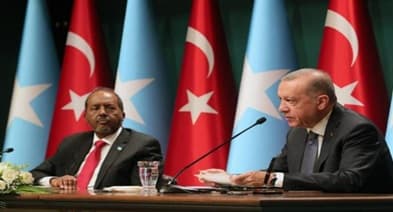
A high-level Turkish delegation has arrived in Mogadishu to mediate between the Federal Government of Somalia and the opposition amid ongoing political instability.
What was announced
- Turkey's involvement in Somalia is seen as a conflict of interest, as it has significant financial and geopolitical stakes in the region.
- Turkey has been authorized to train and equip the Somali Army forces in exchange for 30 percent of revenues from Somalia's exclusive economic zone.
- Turkey's state energy company holds exclusive rights to explore offshore blocks in Somali waters, potentially controlling up to 30 billion barrels of reserves.
Context
The arrival of the Turkish delegation coincides with heavy gunfire and unrest in Mogadishu, highlighting the political crisis in Somalia.
“This is not partnership, it is economic vassalage disguised as maritime security.”
Why this matters: Understanding Turkey's role in Somalia is crucial for grasping the complexities of the ongoing political crisis and the implications for Somali sovereignty.
Original English report
Original sourceOriginal
Original source text
The original source text is split into readable paragraphs for easier review.
By Dayib Sh. Ahmed
In Mogadishu, Somalia, during periods of profound political uncertainty, states often rely upon designated international mediators to stabilize governance and prevent systemic collapse. Ordinarily, such mediators are expected to function as neutral arbiters, facilitating de-escalation and guiding the parties back from the brink of institutional breakdown.
However, where the appointed mediator simultaneously assumes the role of principal architect and primary beneficiary of the underlying crisis, the character of diplomatic engagement is fundamentally altered. In such circumstances, diplomacy may be construed as having deviated from its customary neutral function and instead becoming an instrument intertwined with, or contributing to, the perpetuation of the very instability it is meant to resolve.
As heavy gunfire shakes Mogadishu and smoke rises over residential neighborhoods , a high-level Turkish delegation composed of diplomats and intelligence officials has arrived in the capital. Ostensibly, their mission is to facilitate dialogue between the Federal Government of Somalia and a fractured opposition reeling from a heavily contested political transition. In reality, Ankara is entering a theater of its own making, attempting to arbitrate a crisis where its own financial, geopolitical, and military interests are deeply and inextricably entangled. The current push for mediation is an exercise in political theater, designed not to restore a consensus-based democracy, but to rubber-stamp an authoritarian slide.
Source noteWhy this story appears
This report is shown because it came from Warkasta’s monitored source network and matches the current section, recency, and coverage labels.
Why this story appears
This report is shown because it came from Warkasta’s monitored source network and matches the current section, recency, and coverage labels.
- Source count
- 1
- Sources used
- Wardheer News
- Language mix
- English
- Translation status
- Shown in its original language
- AI synthesis
- No AI synthesis is used for this story panel
Stay informed
Get Warka in your inbox. No noise, just what matters.